- Monday - Saturday 9AM -5PM
Ultrasonic Testing is not just about understanding sound waves or operating an instrument—it is about knowing how to make accurate inspection decisions in real industrial environments.
In today’s industrial world, quality and safety are more important than ever. From oil refineries and power plants to manufacturing facilities and offshore platforms, every critical component must perform reliably under demanding conditions. Detecting hidden defects before they become failures is where Ultrasonic Testing (UT) plays a vital role.
Our NDT Training Ultrasonic Testing (UT) Level-II course is designed for professionals who want to move beyond the basics and develop the technical expertise required to perform advanced ultrasonic inspections. Through a combination of classroom instruction, practical laboratory sessions, and real-world inspection exercises, participants gain the confidence to identify internal discontinuities, interpret inspection results, and prepare professional inspection reports that align with industry expectations.

The demand for qualified UT inspectors continues to grow as industries place greater emphasis on equipment reliability, product quality, and workplace safety. Our training program has been developed to help participants meet these expectations through a balanced approach to theory and practical application
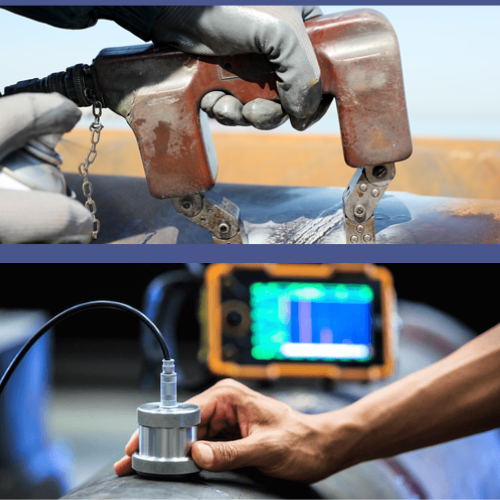
Practical training forms the core of this course. Participants gain valuable hands-on experience using professional ultrasonic testing instruments, calibration blocks, probes, and inspection specimens under expert supervision.
The course covers the principles, techniques, and inspection procedures commonly applied in industrial environments, enabling participants to develop skills that are immediately applicable in the workplace.
Training is delivered using professional ultrasonic flaw detectors and inspection accessories that reflect the equipment commonly used throughout the inspection industry.
Ultrasonic testing professionals are trusted to inspect some of the world’s most critical infrastructure—from pressure vessels and pipelines to power plants, offshore platforms, and heavy industrial equipment. As industries continue to prioritize asset integrity and preventive maintenance, the demand for competent UT Level-II inspectors continues to grow.
This course is carefully structured to help participants build both theoretical understanding and practical inspection capability.
By completing the NDT Training Ultrasonic Testing (UT) Level-II program.
you will learn how to:
Upon successful completion of the course, participants will be able to perform ultrasonic inspections with greater confidence, technical understanding, and professional competence.
You will be able to:
Perform Independent Ultrasonic Inspections
Conduct inspections on welds, pipes, pressure vessels, structural components, and engineering materials using recognized inspection procedures.
Calibrate Ultrasonic Equipment Correctly
Set up ultrasonic flaw detectors, adjust sensitivity, verify calibration, and prepare equipment before inspection begins.
Detect and Evaluate Internal Discontinuities
Identify defects such as:
Interpret Inspection Data
Develop the ability to analyze ultrasonic indications, distinguish relevant signals from non-relevant indications, and make informed inspection decisions.
Produce Professional Inspection Reports
Document inspection findings clearly using industry-accepted reporting methods, ensuring traceability and compliance with quality requirements.
Support Quality Assurance Programs
Apply ultrasonic testing effectively within manufacturing, fabrication, maintenance, and construction projects to improve quality, safety, and operational reliability.
Module 1 – Introduction to Non-Destructive Testing (NDT)
Begin with the fundamentals of Non-Destructive Testing and understand how different inspection methods contribute to quality assurance, asset integrity, and workplace safety. This module also introduces the role of UT within the broader NDT industry and explains where it is most effectively applied.
Topics Covered
Module 2 – Principles of Ultrasonic Testing
Develop a solid understanding of how ultrasonic waves behave inside different materials and how this behaviour is used to locate hidden discontinuities.
Topics Covered
Module 3 – Ultrasonic Testing Equipment
Become familiar with the equipment used during industrial inspections and learn how every component contributes to accurate testing.
Topics Covered
Module 4 – Equipment Calibration
Accurate inspection begins with proper calibration. This module teaches participants how to prepare equipment before performing inspections.
Topics Covered
Module 5 – Straight Beam Inspection
Learn how straight beam techniques are used for detecting laminations, inclusions, internal defects, and thickness variations in engineering materials.
Practical Applications
Module 6 – Angle Beam Inspection
Angle beam inspection is one of the most widely used techniques for weld examination. Participants learn how to inspect welded joints accurately while interpreting reflected ultrasonic signals.
Practical Applications
Module 7 – Weld Defect Evaluation
Understand how ultrasonic testing is used to identify and evaluate discontinuities commonly found in welded joints.
Participants will learn how to recognize:
Module 8 – Thickness Measurement
Discover how ultrasonic equipment can accurately measure material thickness without damaging the component, making it an essential tool for corrosion monitoring and preventive maintenance.
Applications include:
Module 9 – Signal Interpretation
One of the most valuable skills for a UT Level-II inspector is the ability to interpret inspection data correctly.
Participants will learn:
Module 10 – Inspection Procedures & Reporting
Inspection is only complete when findings are properly documented. This module focuses on preparing professional inspection reports that meet industry requirements.
Topics include:
This course is suitable for individuals involved in inspection, manufacturing, fabrication, maintenance, and quality assurance who want to strengthen their ultrasonic testing skills.
It is particularly beneficial for:
Whether you are already working in industry or preparing to enter the inspection field, this course provides practical knowledge that can be applied immediately in the workplace.
To get the most from this training, participants should have a basic understanding of engineering principles and a strong interest in inspection technologies.
Recommended for individuals who:
If you are unsure whether this course matches your experience level, our training advisors can help you determine the most suitable learning pathway.
As industries continue to invest in quality assurance, preventive maintenance, and asset integrity, the demand for skilled ultrasonic testing professionals continues to grow. Organizations across the world rely on qualified inspectors to evaluate critical components and prevent costly equipment failures.
After completing this course, you may pursue roles such as:
These opportunities exist across sectors including oil & gas, petrochemical, construction, power generation, manufacturing, marine, aerospace, and heavy engineering.
Choosing the right training provider can make a significant difference in your professional development. At AMS Academy, we focus on delivering training that prepares participants for real industrial challenges rather than simply covering theoretical concepts.
Develop confidence through supervised laboratory sessions using professional ultrasonic testing equipment.
Our training laboratories are equipped to simulate real industrial inspection scenarios, helping participants gain practical experience before entering the field.
Learn from professionals with extensive experience in inspection, quality assurance, maintenance, and engineering projects.
Every lesson is designed to strengthen the skills employers expect from competent UT Level-II professionals.
Theory provides the foundation, but practical experience develops confidence. Every participant spends significant time performing inspections under the supervision of experienced instructors.
Throughout the course, trainees work on real engineering components that closely resemble industrial inspection scenarios. This practical approach allows participants to understand not only how to operate ultrasonic equipment, but also why certain inspection decisions are made.
The objective is to ensure that every participant is capable of applying classroom knowledge during actual field inspections.
Join our NDT Training Ultrasonic Testing (UT) Level-II course and take the next step toward becoming a skilled ultrasonic testing professional. Contact our team today to learn more about upcoming training schedules, admission requirements, and how this course can help you achieve your career goals.
Lorem ipsum dolor sit amet, consectetur adipiscing elit tristique dolor nec.

Lorem ipsum dolor sit amet, consectetur adipiscing elit.
Lorem ipsum dolor sit amet, consectetur adipiscing elit.
Lorem ipsum dolor sit amet, consectetur adipiscing elit.
Lorem ipsum dolor sit amet, consectetur adipiscing elit.
Have questions about our NDT Training Ultrasonic Testing (UT) Level-II course? Find answers to the most common questions about eligibility, course content, certification, career opportunities, and how this internationally recognized training can help you build a successful career in machinery condition monitoring and predictive maintenance.